What Is UUID? Complete Guide for Developers
Introduction
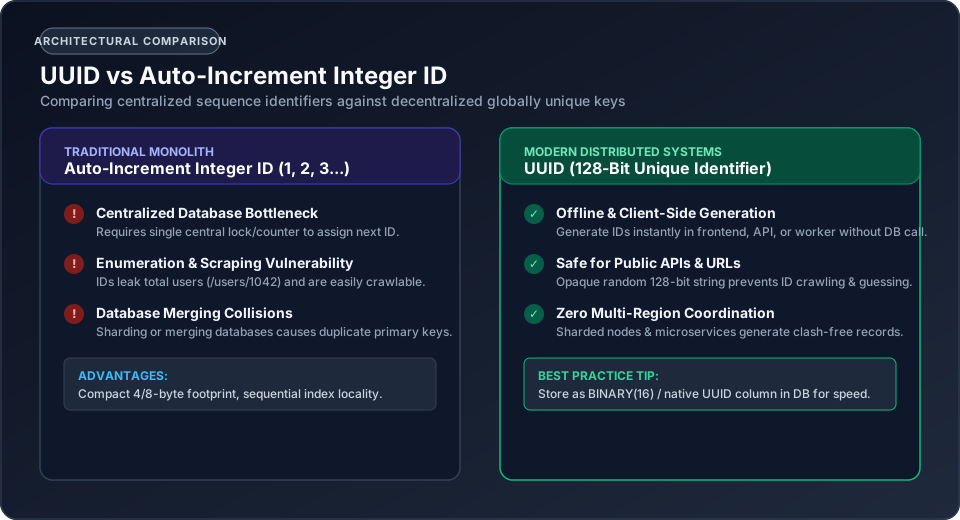
In any non-trivial software system, every database row, user session, payment transaction, event message, and uploaded asset requires a distinct identifier. In early application architecture, the default choice was simple: let the database engine assign an auto-incrementing integer (1, 2, 3, 4...).
This approach works seamlessly for isolated, single-server monolithic applications. But the moment your architecture expands—whether through database sharding, microservice boundaries, client-side offline data sync, multi-region database clusters, or public REST and GraphQL APIs—sequential integers quickly become a bottleneck.
Sequential IDs force every component in your ecosystem to communicate with a single database coordinator just to obtain an ID before creating a record. Worse, publishing sequential integers in public URLs (such as /api/users/1042) exposes your business metrics to competitors and leaves endpoints vulnerable to trivial automated web scraping and enumeration attacks.
This architectural challenge is precisely what is UUID designed to solve.
By providing a mathematical framework for generating globally unique 128-bit identifiers independently across millions of client devices, background workers, and distributed microservices, UUIDs eliminate the need for a centralized ID broker while preventing namespace collisions.
In this comprehensive guide, we will break down the UUID meaning, explore the inner workings of different UUID versions, compare UUIDs with traditional auto-increment integers and GUIDs, evaluate database indexing and performance trade-offs, and show you how to generate and validate UUIDs in modern programming languages.
What Is UUID?
A UUID (Universally Unique Identifier) is a standardized 128-bit numerical label defined by RFC 4122 (and modernized in RFC 9562). Its fundamental purpose is to enable distributed software systems to uniquely identify information without requiring central coordination, registration authorities, or database locks.
When formatted for human readability and string storage, a UUID is represented as a 36-character string consisting of 32 hexadecimal digits and four separating hyphens arranged in an 8-4-4-4-12 grouping:
550e8400-e29b-41d4-a716-446655440000
Because a 128-bit integer provides $2^{128}$ (approximately $3.4 \times 10^{38}$) unique possible values, any two properly generated UUIDs are practically guaranteed to be distinct, even if generated simultaneously on two separate servers on opposite sides of the globe with zero network connectivity.
Where Developers Use UUIDs
Software engineers across frontend, backend, DevOps, and database engineering rely on UUIDs across everyday workflows:
- Primary Keys in Distributed Databases: Eliminating single-master auto-increment bottlenecks in PostgreSQL, MySQL, CockroachDB, and Cassandra.
- Public API Resource Identifiers: Masking internal database table counters behind opaque IDs in REST, GraphQL, and gRPC payloads.
- Microservice Trace and Correlation IDs: Attaching a single transaction ID to an HTTP request that propagates across dozens of downstream microservices for distributed logging.
- Idempotency Keys: Ensuring payment gateways (like Stripe or PayPal) do not double-charge customers when network retries occur.
- Object and File Storage Keys: Naming uploaded media files in AWS S3 or Cloudflare R2 without worrying about filename collisions.
Why Do Developers Use UUID?
To understand why UUIDs have become an industry standard in modern cloud engineering, let us examine the specific real-world scenarios where traditional identification strategies break down.
1. Decentralized, Offline ID Creation
With traditional auto-increment integer IDs, your client application or background queue cannot determine an entity's primary key until the record is successfully written to the database master.
With UUIDs, an identifier can be created at the source:
- A mobile application operating offline can create orders, items, and relationships locally with valid UUID primary keys, and sync them seamlessly to the cloud once network connectivity is restored.
- A frontend Single Page Application (SPA) can generate an entity's ID immediately upon form submission, enabling optimistic UI updates and instant navigation to
/projects/{uuid}before the network request finishes.
2. Multi-Region and Distributed Database Sharding
In modern horizontally scaled architectures (such as CockroachDB, DynamoDB, MongoDB, or sharded PostgreSQL clusters), multiple database nodes accept concurrent write operations across different geographic regions (e.g., us-east, eu-west, ap-southeast).
If these nodes relied on sequential numbers, node synchronization would require distributed consensus algorithms (like Raft or Paxos) for every single insert, resulting in massive network latency and catastrophic write bottlenecks. Because UUID generation is decentralized, every shard writes records at full speed with zero cross-region coordination.
3. Merging Disparate Datasets Without Collisions
Imagine two companies merging their customer databases, or an enterprise migrating separate staging and production databases into a unified data warehouse. If both systems used integer primary keys (id = 1, 2, 3...), merging tables requires re-mapping thousands of foreign keys, risking data corruption. Because UUIDs are globally unique, tables can be merged into a single database with zero key collisions.
4. Preventing Enumeration and Business Metric Harvesting
When an e-commerce platform issues order receipts via sequential URLs:
/orders/1001/orders/1002
A malicious actor or competing business can easily write a script to scrape all orders sequentially. Furthermore, by placing an order on Monday (/orders/1000) and another on Tuesday (/orders/1250), a competitor instantly knows your platform processed exactly 250 orders in 24 hours.
Switching to UUIDs (/orders/b9f2c178-831d-44a6-95b7-7e61833c82e0) produces completely opaque, unguessable URLs that protect private data and prevent unauthorized automated enumeration.
UUID Format Explained
A standard canonical UUID is an encoded 128-bit binary value displayed as a 36-character string. Let us analyze the anatomy of this structure.
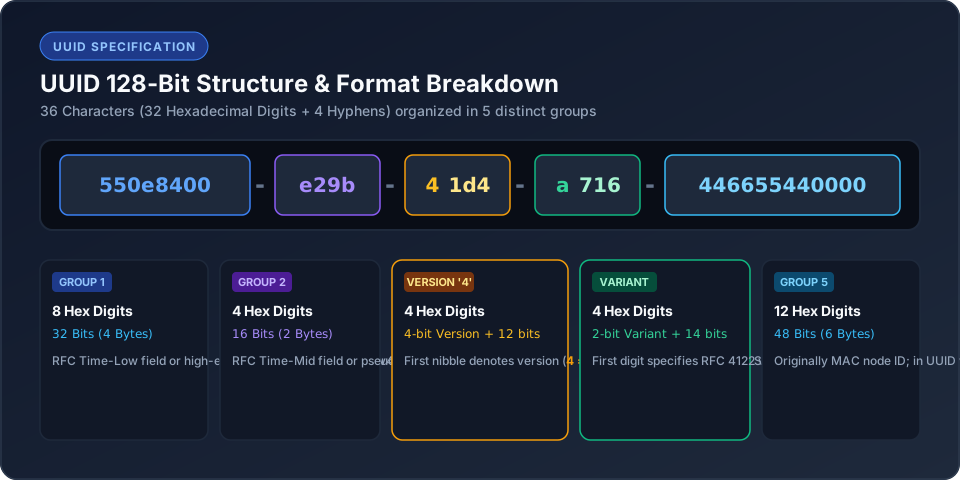
The canonical string format is split into five distinct hexadecimal fields separated by hyphens:
$$\text{UUID} = \underbrace{\text{xxxxxxxx}}{\text{8 hex digits (32 bits)}} - \underbrace{\text{xxxx}}{\text{4 hex digits (16 bits)}} - \underbrace{\text{Mxxx}}{\text{4 hex digits (16 bits)}} - \underbrace{\text{Nxxx}}{\text{4 hex digits (16 bits)}} - \underbrace{\text{xxxxxxxxxxxx}}_{\text{12 hex digits (48 bits)}}$$
Let us inspect what each section represents under RFC 4122:
| Group | Field Name | Hex Length | Bit Length | Description |
|---|---|---|---|---|
| Group 1 | time_low | 8 chars | 32 bits | Low 32 bits of timestamp (v1) or random entropy (v4) |
| Group 2 | time_mid | 4 chars | 16 bits | Middle 16 bits of timestamp (v1) or random entropy (v4) |
| Group 3 | time_hi_and_version | 4 chars | 16 bits | High 12 bits of timestamp with Version number (M) in first nibble |
| Group 4 | clock_seq_and_variant | 4 chars | 16 bits | Clock sequence with Variant indicator (N) in first 2–3 bits |
| Group 5 | node | 12 chars | 48 bits | 48-bit MAC address (v1) or 48 bits of random entropy (v4) |
Deciphering the Version (M)
The first digit of the third group (M) indicates the UUID version (from 1 through 8).
For example, in 550e8400-e29b-41d4-a716-446655440000, the third group starts with 4 (41d4), confirming it is a UUID Version 4 (randomly generated identifier).
Deciphering the Variant (N)
The first digit of the fourth group (N) specifies the UUID variant (layout and bit interpretation rules). Under the standard RFC 4122 specification, the two most significant bits are set to 10_2, meaning the hexadecimal character in position N will always be one of four characters: 8, 9, a, or b (or uppercase A, B).
In our example a716, the letter a confirms full compliance with the RFC 4122 / Leach-Salz variant standard.
UUID Versions Explained
RFC standards define multiple UUID versions, each tailored to specific engineering requirements and generation methods.
| Version | Generation Method | Deterministic? | Common Production Usage |
|---|---|---|---|
| UUID v1 | Timestamp (100ns intervals) + Clock Sequence + 48-bit Node MAC Address | Semi-deterministic | Legacy enterprise software, telecom databases. Exposes hardware MAC address. |
| UUID v2 | DCE Security version with POSIX UID/GID identifiers embedded | Semi-deterministic | Rarely used outside legacy POSIX/DCE systems. |
| UUID v3 | MD5 hash of a namespace identifier and an arbitrary name string | Yes (Deterministic) | Reproducible IDs based on input strings (deprecated in favor of v5). |
| UUID v4 | Cryptographically strong pseudo-random number generator (CSPRNG) | No (Pure Random) | Modern standard. General-purpose database keys, APIs, tokens, sessions. |
| UUID v5 | SHA-1 hash of a namespace identifier and an arbitrary name string | Yes (Deterministic) | Deterministic mapping (e.g., generating identical UUIDs for URLs/URNs). |
| UUID v6/v7 | Modern time-ordered hybrid with millisecond/microsecond precision + random entropy | Semi-random & Sequential | High-performance B-Tree database indexing, time-series events. |
Why UUID v4 Is the Industry Favorite
Among all available versions, UUID Version 4 is by far the most widely adopted across modern web applications, cloud architectures, and open-source frameworks.
Unlike Version 1, UUID v4 does not require access to hardware MAC addresses (eliminating privacy and network spoofing concerns) and does not rely on monotonic system clocks. Unlike Versions 3 and 5, it requires no namespace setup or input string hashing. It is simple, fast, cryptographically secure, and supported natively across virtually every modern programming language runtime.
What Is UUID v4?
A UUID v4 is an identifier generated almost entirely from cryptographically secure pseudo-random numbers.

Out of the 128 total bits in a UUID:
- 4 bits are fixed to declare Version 4 (
0100in binary). - 2 bits are fixed to declare the standard RFC 4122 variant (
10in binary). - The remaining 122 bits are generated using a Cryptographically Secure Pseudo-Random Number Generator (CSPRNG).
The Mathematical Scale of 122 Random Bits
A total of 122 random bits yields:
$$2^{122} \approx 5,316,911,983,139,663,491,611,566,370,869,747,200 \text{ unique combinations}$$
That is approximately $5.3 \times 10^{36}$ possible UUIDs.
To put this astronomical figure into perspective:
- If a high-throughput distributed system generated 1 billion UUID v4 identifiers every single second for 100 consecutive years, the mathematical probability of generating even a single duplicate ID is less than $0.000000000001%$ ($10^{-14}$).
When building cloud applications, you can safely generate UUID v4 identifiers across thousands of distributed servers with zero cross-system coordination and zero fear of duplicate keys.
Need to generate secure random UUIDs instantly? You can generate single or bulk RFC-compliant identifiers right in your browser with our free UUID v4 generator.
UUID vs Auto Increment ID
Choosing between UUIDs and sequential auto-incrementing integer IDs is one of the most fundamental database design decisions engineers face. Neither choice is universally superior; each solves a distinct set of architectural requirements.
| Feature / Metric | UUID (e.g., UUID v4) | Auto-Increment Integer (INT / BIGINT) |
|---|---|---|
| Storage Size | 16 bytes binary / 36 bytes text | 4 bytes (INT) or 8 bytes (BIGINT) |
| Generation Location | Client, backend service, or database (decentralized) | Database engine only (centralized) |
| Distributed Scaling | Flawless (zero cross-node locks) | Difficult (requires coordinated shard offsets) |
| Security & Obscurity | High (opaque, unguessable, non-sequential) | Low (easily crawlable, leaks business metrics) |
| B-Tree Index Locality | Random write fragmentation in classical B-Trees | Append-only sequential locality (optimal page caching) |
| Human Readability | Difficult to memorize or communicate verbally | Trivial to read, memorize, and debug (ID: 42) |
| Data Merging | Painless (collision-free across disparate databases) | Highly prone to duplicate key collisions |
When to Choose UUIDs:
- Distributed, microservice, or multi-tenant architectures.
- Public URLs, REST APIs, and client-facing endpoints.
- Mobile and offline-first applications that require optimistic client-side ID assignment.
- Multi-master, sharded, or multi-region database clusters (CockroachDB, DynamoDB, Spanner).
- Event-driven systems requiring correlation and idempotency keys.
When to Choose Auto-Increment IDs:
- Small to medium internal tools with a single relational database instance.
- High-volume write-heavy tables where minimizing disk footprint and index memory overhead is the top priority.
- Purely internal lookup tables (e.g.,
order_status_types,currency_codes,role_permissions). - Systems where human operators frequently communicate IDs verbally or via phone support.
UUID vs GUID: What Is the Difference?
A common question among developers entering the Microsoft or .NET ecosystems is: "What is the difference between a UUID and a GUID?"
The short answer: A GUID (Globally Unique Identifier) is Microsoft's implementation of the UUID standard.
- UUID (Universally Unique Identifier) is the international open standard defined by the IETF in RFC 4122 and ISO/IEC 11578:1996.
- GUID (Globally Unique Identifier) is the term adopted by Microsoft during the development of COM (Component Object Model), OLE, ActiveX, and later embedded across Windows, C#, and Microsoft SQL Server (
UNIQUEIDENTIFIERdatatype).
In virtually all practical modern scenarios, UUID and GUID refer to the exact same 128-bit structure.
The only historical technical distinction lies in binary byte ordering (endianness): Microsoft GUIDs historically encoded the first three fields in little-endian byte format in memory and disk storage, whereas RFC 4122 UUIDs specify big-endian (network byte order). However, when converted to text strings, both conform to the exact same 36-character 8-4-4-4-12 format.
How UUID Works in Applications
To see how UUIDs streamline software architectures, let us examine three standard engineering implementations: database schema design, RESTful API routing, and microservice event tracing.
1. Database Schema Implementation (PostgreSQL Example)
Modern relational databases like PostgreSQL include native UUID datatypes that store identifiers in an optimized 16-byte binary format rather than a 36-byte string:
-- Enable the pgcrypto extension for native v4 generation (PostgreSQL < 13)
-- In PostgreSQL 13+, gen_random_uuid() is built-in natively
CREATE TABLE users (
    id UUID PRIMARY KEY DEFAULT gen_random_uuid(),
    email VARCHAR(255) NOT NULL UNIQUE,
    full_name VARCHAR(100) NOT NULL,
    created_at TIMESTAMP WITH TIME ZONE DEFAULT CURRENT_TIMESTAMP
);

CREATE TABLE orders (
    id UUID PRIMARY KEY DEFAULT gen_random_uuid(),
    user_id UUID NOT NULL REFERENCES users(id) ON DELETE CASCADE,
    total_amount_cents INTEGER NOT NULL,
    status VARCHAR(50) NOT NULL DEFAULT 'pending',
    created_at TIMESTAMP WITH TIME ZONE DEFAULT CURRENT_TIMESTAMP
);

-- Insert a new record; PostgreSQL automatically generates a valid UUID v4
INSERT INTO users (email, full_name)
VALUES ('sarah.developer@example.com', 'Sarah Connor');

-- Query records using standard UUID formatting
SELECT * FROM users WHERE id = 'a8098c1a-f86e-11da-bd1a-00112444be1e';
2. Public REST API Routing (Node.js & Express Example)
In a REST API, using UUIDs ensures that clients and third-party integrations cannot manipulate URL parameters to access unauthorized records:
import express, { Request, Response } from "express";

const app = express();

// Regular expression to validate standard UUID format in route parameters
const UUID_REGEX = /^[0-9a-f]{8}-[0-9a-f]{4}-[1-5][0-9a-f]{3}-[89ab][0-9a-f]{3}-[0-9a-f]{12}$/i;

app.get("/api/v1/orders/:orderId", async (req: Request, res: Response) => {
  const { orderId } = req.params;

  // Validate UUID input before executing database queries
  if (!UUID_REGEX.test(orderId)) {
    return res.status(400).json({
      error: "INVALID_IDENTIFIER",
      message: "The provided order ID must be a valid RFC 4122 UUID.",
    });
  }

  const order = await database.orders.findUnique({ where: { id: orderId } });

  if (!order) {
    return res.status(404).json({ error: "Order not found" });
  }

  return res.json({ data: order });
});
3. Distributed Microservice Request Correlation
When a user triggers an action in a distributed cloud application, the request may bounce across an API gateway, authentication service, billing service, and notification queue. By attaching a UUID correlation ID at the gateway, all downstream logs can be indexed and traced in Datadog, Grafana Loki, or AWS CloudWatch:
// Express / NestJS Trace Middleware Example
import { Request, Response, NextFunction } from "express";
import crypto from "crypto";

export function correlationIdMiddleware(req: Request, res: Response, next: NextFunction) {
  // Read existing correlation ID or generate a fresh UUID v4
  const correlationId = (req.headers["x-correlation-id"] as string) || crypto.randomUUID();

  // Set header on incoming context and outgoing response
  req.headers["x-correlation-id"] = correlationId;
  res.setHeader("X-Correlation-ID", correlationId);

  console.log(`[Trace: ${correlationId}] Incoming ${req.method} request to ${req.url}`);
  next();
}
How to Generate UUID in Code
Modern programming languages provide built-in, highly optimized functions to generate UUIDs. Here is how to create UUIDs across the most popular development environments.
1. JavaScript / TypeScript (Node.js & Modern Browsers)
In modern JavaScript environments (Node.js 16.7+, Deno, Bun, and all modern web browsers), the Web Crypto API provides native, cryptographically secure UUID v4 generation without third-party npm packages:
// Native Web Crypto API (Browser and Node.js 16.7+)
const uuid = crypto.randomUUID();
console.log(uuid);
// Output: "f47ac10b-58cc-4372-a567-0e02b2c3d479"
If you are maintaining a legacy codebase or need specific versions (such as UUID v5 or v1), the official uuid npm package is standard:
npm install uuid
npm install --save-dev @types/uuid
import { v4 as uuidv4, v5 as uuidv5 } from "uuid";

// Generate random UUID v4
const randomId: string = uuidv4();

// Generate deterministic UUID v5 from a URL namespace
const MY_NAMESPACE = "6ba7b810-9dad-11d1-80b4-00c04fd430c8"; // RFC URL namespace
const deterministicId: string = uuidv5("https://www.devtoolkit.my", MY_NAMESPACE);

console.log("Random v4:", randomId);
console.log("Deterministic v5:", deterministicId);
2. Python
Python includes standard library support for UUIDs in the uuid module:
import uuid

# Generate a cryptographically strong UUID v4
random_uuid = uuid.uuid4()
print(f"UUID string: {random_uuid}")
print(f"Hex digits:  {random_uuid.hex}")
print(f"Integer representation: {random_uuid.int}")
print(f"Version: {random_uuid.version}, Variant: {random_uuid.variant}")

# Generate a deterministic UUID v5
namespace_url = uuid.NAMESPACE_URL
named_uuid = uuid.uuid5(namespace_url, "https://www.devtoolkit.my")
print(f"Named UUID v5: {named_uuid}")
3. PHP
Modern PHP 8+ supports UUID generation via the ramsey/uuid library or native random bytes:
<?php
// Using the industry-standard ramsey/uuid library
use Ramsey\Uuid\Uuid;

$uuid = Uuid::uuid4();
echo $uuid->toString(); // e.g. 25769c6c-d34d-4bfe-ba98-e0ee856f3e7a

// Native PHP 8 fallback without external packages
function generate_uuid_v4(): string {
    $data = random_bytes(16);
    $data[6] = chr(ord($data[6]) & 0x0f | 0x40); // set version to 0100
    $data[8] = chr(ord($data[8]) & 0x3f | 0x80); // set variant to 10
    return vsprintf('%s%s-%s-%s-%s-%s%s%s', str_split(bin2hex($data), 4));
}

echo generate_uuid_v4();
4. Online UUID Generator
When testing API payloads in Postman, seeding local test databases, configuring staging mock fixtures, or generating correlation IDs on the fly, developers frequently need fast, collision-free UUIDs without writing temporary scripts.
You can use the DevToolkit UUID Generator to generate UUID online instantly. It supports bulk generation up to 10,000 UUIDs at a time, uppercase/lowercase formatting, hyphen stripping, and one-click clipboard copying with 100% client-side privacy.
Are UUIDs Truly Unique?
When discussing UUIDs, a common myth is that UUIDs are "100% mathematically impossible to duplicate."
In strict mathematics, this claim is false: because a UUID is composed of a finite number of bits ($128$ bits), the total pool of possible values is finite ($2^{128}$). Therefore, collisions are theoretically possible under the Pigeonhole Principle.
However, in practical software engineering, UUID v4 collision probability is so negligible that it can be treated as zero for all real-world applications.
Understanding the Birthday Problem
The probability of collision in random systems is governed by the Birthday Paradox. The approximation formula for finding a collision among $n$ generated UUIDs from a pool of $N = 2^{122}$ is:
$$p(n) \approx 1 - e^{-\frac{n^2}{2N}}$$
Let us calculate the exact probability of collision for various generation volumes:
| Total UUIDs Generated | Approximate Collision Probability | Real-World Equivalent Comparison |
|---|---|---|
| 1 Billion ($10^9$) | $\approx 10^{-19}$ | Far lower than being struck by lightning multiple times in a lifetime |
| 1 Trillion ($10^{12}$) | $\approx 10^{-13}$ | Less than the probability of an uncorrectable cosmic ray hardware memory bit-flip |
| 100 Trillion ($10^{14}$) | $\approx 0.000000094%$ ($10^{-9}$) | Essentially zero risk for global enterprise scale |
| $2.71 \times 10^{18}$ | $\approx 50%$ | Requires generating 1 billion UUIDs per second for over 85 consecutive years |
As long as your software uses a genuine Cryptographically Secure Pseudo-Random Number Generator (such as crypto.randomUUID() or Linux /dev/urandom) rather than an unseeded pseudo-random function like Math.random(), you will never experience a UUID collision in your application's lifetime.
UUID Security Considerations
While UUIDs provide immense architectural advantages, developers frequently make dangerous assumptions regarding their security properties.
1. A UUID Is Not an Encryption Key or Access Token
A UUID v4 is an opaque, unguessable identifier, but it is not encryption and does not provide cryptographic authentication.
If you create an endpoint like:
GET /api/documents/7b43b6c4-171b-4f96-857e-3982e5b7a192
And return sensitive financial or medical records without verifying the user's session token and authorization permissions, your API is insecure. If an attacker intercepts the UUID through server access logs, browser history, or network sniffing, the UUID alone provides zero defense. Always enforce strict server-side Authorization middleware.
2. UUID v1 Leaks MAC Addresses and Timestamps
If your system uses UUID Version 1, the last 48 bits encode the network card's physical MAC address, and the first 60 bits encode the exact UTC timestamp of generation down to 100-nanosecond intervals.
Using UUID v1 in user IDs or public URLs exposes:
- The exact physical hardware or virtual machine cluster that generated the ID.
- The precise date and time the record was created.
- The ability to predict past and future UUIDs generated by the same node.
For all modern public-facing applications, stick strictly to UUID v4 or time-ordered random variants (like UUID v7).
3. Avoid Insecure Random Number Generators
Never construct UUIDs using standard pseudo-random functions like JavaScript's Math.random() or standard C rand(). These functions use deterministic linear congruential algorithms with low internal state entropy, making their outputs predictable to attackers. Always use crypto.randomUUID() or OS-level CSPRNG sources.
Common UUID Mistakes Developers Make
Avoid these common pitfalls when designing systems with UUIDs:
1. Storing UUIDs as VARCHAR(36) Strings in SQL Databases
Storing UUIDs as 36-character ASCII text strings (VARCHAR(36) or TEXT) requires 36 bytes per row plus string index overhead. In contrast, storing UUIDs in native binary format requires only 16 bytes.
- In PostgreSQL, always use the native
UUIDcolumn type. - In MySQL 8+, use
BINARY(16)withUUID_TO_BIN()andBIN_TO_UUID()helper functions. - In SQLite, store UUIDs as
BLOB(16 bytes) or text if database size is small.
Storing UUIDs in binary format cuts table disk size and B-Tree index memory consumption by more than 55%, dramatically accelerating database caching and query execution.
2. Ignoring B-Tree Index Fragmentation with Random UUIDs
Because UUID v4 values are completely random, inserting millions of rows into a traditional clustered B-Tree index (such as MySQL InnoDB's clustered primary key) causes severe index fragmentation.
Every new insert writes to a random location in the B-Tree, forcing frequent page splits, memory cache thrashing, and high disk I/O.
- Solution: For massive write-heavy tables in MySQL/PostgreSQL, consider using sequential time-ordered identifiers like UUID v7 or ULID, or maintain an internal auto-increment integer for the clustered index while placing a unique secondary index on the UUID column for public API access.
3. Using UUIDs Where Simple Enumerations Belong
Using a 128-bit UUID for small static lookup tables with 5 to 10 fixed values (e.g., user_roles: ADMIN, EDITOR, VIEWER) adds unnecessary complexity, slows down joins, and makes debugging difficult. Use lightweight integers or string enums for static reference data.
UUID Best Practices for Modern Engineering
To maximize performance, security, and developer productivity when working with UUIDs, adhere to these five industry best practices:
┌─────────────────────────────────────────────────────────────────────────┐
│                       UUID ENGINEERING BEST PRACTICES                   │
├─────────────────────────────────────────────────────────────────────────┤
│ 1. DEFAULT TO UUID V4        Use CSPRNG random generation for apps      │
│ 2. OPTIMIZE STORAGE          Use native UUID / BINARY(16) in databases │
│ 3. VALIDATE STRICTLY         Sanitize input via RFC 4122 regex/schema  │
│ 4. ENFORCE AUTHORIZATION     Never rely on UUID opacity for security    │
│ 5. STANDARDIZE CASING        Always normalize to lowercase strings     │
└─────────────────────────────────────────────────────────────────────────┘
- Default to UUID v4 for General Workloads: Unless you specifically require deterministic hashing (v5) or time-ordered sequential B-Tree performance (v7), UUID v4 provides the ideal balance of speed, cross-platform compatibility, and zero-collision safety.
- Normalize Strings to Lowercase: RFC 4122 states that hexadecimal characters should be emitted as lowercase upon generation, but systems must accept uppercase on input. Always normalize incoming UUIDs to lowercase (
uuid.toLowerCase()) before performing database lookups or cache key lookups to avoid subtle cache-miss bugs. - Validate UUID Input at the Boundary: Always validate UUID strings at your API gateway or controller layer using schema validators (like Zod, Yup, Joi, or Pydantic) before executing expensive database queries:
import { z } from "zod"; const UserParamsSchema = z.object({ userId: z.string().uuid({ message: "Invalid UUID format" }), }); - Document Your Primary Key Strategy: Maintain clear architectural documentation explaining where UUIDs are used (e.g., public APIs, distributed events) versus internal integer keys.
- Leverage Quality Developer Utilities: Equip your development team with reliable browser-based tools to inspect, format, and generate test identifiers during development sprints.
Frequently Asked Questions (FAQ)
What does UUID stand for?
UUID stands for Universally Unique Identifier. It is a standardized 128-bit numerical label defined by RFC 4122 and ISO/IEC 11578:1996 used to uniquely identify objects, records, and resources across distributed computing systems without central coordination.
What is UUID used for?
Developers use UUIDs as database primary keys, public REST and GraphQL API resource identifiers, correlation and trace IDs in microservice logging, payment idempotency keys, session and token identifiers, and unique file naming keys in cloud storage buckets.
Is UUID better than auto increment ID?
Neither is universally better; they serve different architectural needs. Auto-increment integer IDs are smaller (4 to 8 bytes) and provide optimal B-Tree sequential indexing performance in single monolithic databases. UUIDs excel in distributed databases, microservices, multi-region architectures, and public APIs where decentralized offline generation and protection against ID enumeration are essential.
What is UUID v4?
UUID v4 is the most popular UUID version. It generates identifiers using 122 bits of cryptographically secure random numbers, with 6 bits reserved for version and variant flags. It provides $5.3 \times 10^{36}$ unique combinations, making collision probability practically zero.
Can UUIDs collide?
In theoretical mathematics, yes, because the total pool of 128-bit values is finite. In practical engineering, the probability of two properly generated UUID v4 values colliding is so astronomically small that generating 1 billion UUIDs every second for decades would still yield a virtually zero chance of collision.
Is UUID secure?
UUIDs are opaque identifiers, not security or encryption mechanisms. While UUID v4 is practically unpredictable and prevents automated ID enumeration attacks, you must never treat a UUID as an authentication token or secret key without implementing proper access control and authorization middleware.
How do I generate a UUID?
You can generate a UUID natively in JavaScript with crypto.randomUUID(), in Python with uuid.uuid4(), or instantly in your web browser using the free DevToolkit UUID Generator.
Explore More Developer Resources
Continue mastering modern database architecture, API security, and developer utilities with our related guides and tools:
- DevToolkit UUID Generator — Generate secure random UUID v4 strings in bulk instantly.
- UUID vs GUID Explained: Key Differences for Developers (Coming Soon)
- UUID Security: Risks, Pitfalls, and Best Practices (Coming Soon)
- How UUIDs Work in Distributed Systems & Microservices (Coming Soon)
- JSON Formatter & Validator — Beautify, minify, and validate JSON payloads.
- Base64 Converter — Encode and decode strings and files in your browser.